
When customers ask AI, what do brands get to know?
In short
When customers ask an AI assistant for advice, they can share exactly what they want. But the brands that could help them may never hear it. Roccai helps businesses collect that missing customer insight and use it across recommendations, marketing, sales and content.

AI is changing businesses from two directions. Inside the organisation, it changes how teams work. Outside it, it changes how customers discover products, compare options, and decide who to buy from. That second shift creates a challenge that goes beyond website traffic: how do you understand customers when part of their decision happens somewhere else?
The search is becoming a conversation
Consider a family planning a holiday. Instead of searching for “family holidays Italy” and browsing several websites, they might ask an AI assistant: “We want a week in Italy with two young children, somewhere quiet near the beach, with a short airport transfer. What would you recommend?”
This illustrative example contains much more than a search term. It reveals preferences, practical constraints and the context behind the decision. AI shopping tools already support this kind of discovery: OpenAI describes ChatGPT shopping research as a way to explain needs, refine recommendations and receive a personalised buyer’s guide. [1]
Websites still matter. But businesses cannot assume that every customer will arrive early in their research. Some may visit after narrowing their options. Others may get enough information without visiting at all. In a study of US browsing activity in March 2025, Pew Research Center found that users clicked traditional Google results on 8% of visits with an AI summary, compared with 15% without one. This describes Google search behaviour, rather than all AI-assisted customer journeys, but illustrates the challenge of relying on website visits alone. [2]
The gap between clicks and customer needs
Even when customers visit a website, their behaviour only tells part of the story. A travel company may know that someone viewed holidays in Italy. It may still not know whether that person wants peace and quiet, activities for children, or a trip with minimal planning.
That gap already exists. When customers explain their needs to an external AI assistant, the business may have even fewer opportunities to ask. The preferences are still being expressed, but the conversation does not automatically become the brand’s customer data.
For businesses, this creates two connected tasks: become easier to discover through AI, and create meaningful opportunities for customers to share what matters to them directly.
How Roccai fits into the changing journey
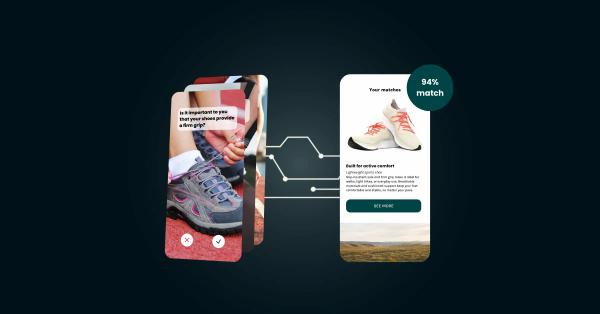
Roccai helps businesses ask customers about their wishes, preferences and intentions through interactive guides. Customers get help finding a suitable option. Businesses gain structured information that complements what they know from clicks and purchases. These voluntarily shared answers are often called zero-party data.
Roccai’s four products play different roles in this process.
Roccai Guide helps businesses ask. Businesses share interactive guides that help customers explore their needs and move towards a relevant choice. The interaction can also generate leads, with context about what each person is looking for.
Roccai Lead Match helps businesses reach potential customers. In this pilot product, Roccai runs the guide and delivers leads matched to the business. It provides a different starting point from Guide, where the business distributes the guide itself.
Roccai Growth Intelligence helps businesses understand the answers. It turns responses and interactions into insight about what customers want and their stated readiness to act. Businesses can use that insight to inform segmentation, follow-up and personalisation. An expressed intention is a useful signal, rather than a guarantee of purchase.
Roccai GEO connects customer insight with AI discovery. Currently in beta, it focuses on AI-readable content informed by customers’ language, questions and intentions. The aim is to help businesses describe their relevance to the needs people bring to AI assistants. It does not guarantee inclusion in an AI-generated answer.
Customer insight needs to lead to action
The value comes from what a business does with the answers. In the holiday example, learning that short transfers and quiet surroundings matter could inform the recommendation, the follow-up email and the content explaining which holidays suit families with young children.
AI can help organise information and identify patterns. Teams still need to interpret the context and decide what to change. Roccai connects that work to information customers have actively shared.
As customer discovery expands beyond the website, businesses need ways to remain visible and stay close to customer needs. Asking relevant questions, offering useful guidance, and acting on the answers gives them a practical place to start.
Sources
[1] OpenAI, Introducing shopping research in ChatGPT, 24 November 2025. https://openai.com/index/chatgpt-shopping-research/
[2] Pew Research Center, Google users are less likely to click on links when an AI summary appears in the results, 22 July 2025. https://www.pewresearch.org/short-reads/2025/07/22/google-users-are-less-likely-to-click-on-links-when-an-ai-summary-appears-in-the-results/


 Book a demo