
Fertility
How Diers turned a donor database into a conversation
A fertility clinic with its own donor bank replaced filters with questions. More than 1,000 people have answered their way to a donor recommendation, in three languages.
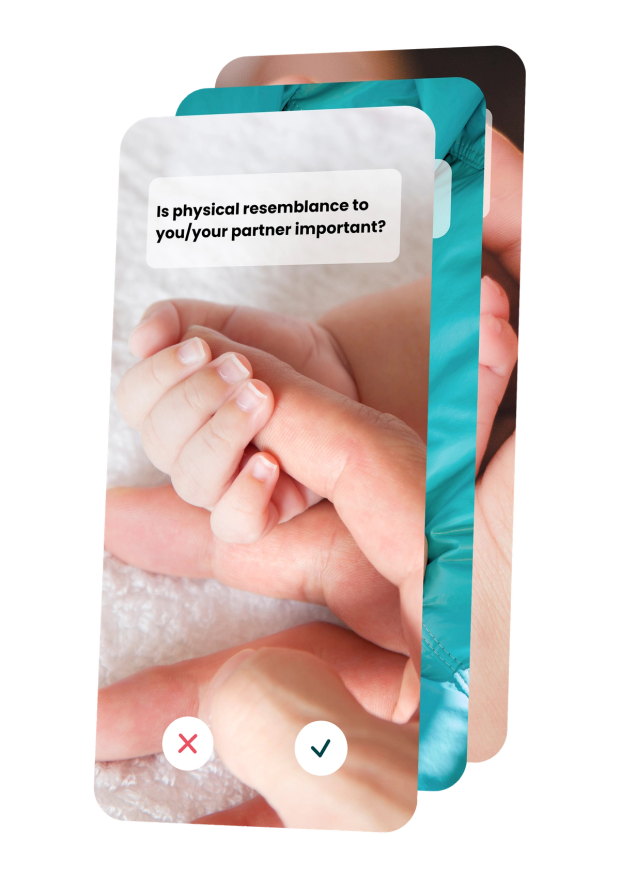
How does Diers use Roccai?
Diers is a Danish fertility clinic and donor bank founded and owned by Liza Diers. It uses Roccai to help prospective parents find a donor, screen potential sperm donors, and collect profile information during onboarding.
Available in Danish, German, and English, the guides make complex donor information easier to navigate, one question at a time.
Why are donor filters difficult to use?
Diers’ donor profiles cover everything from physical traits to education, personality, values and interests. Traditional filters help people narrow the catalogue when they know what they want.
But not everyone knows what matters most at the start. They may change their criteria several times or leave without choosing a donor.
Roccai offers another way to explore: answer questions about what matters to you and receive donor recommendations based on your answers.
What results did Diers get with its donor match guide?
“I disse tider, hvor alting går så stærkt, så er det faktisk mega sejt, at de holder ved hele vejen igennem. In times like these, where everything moves so fast, it is actually really impressive that they stay with it all the way through.”
- 1
1. Donor matching
Helps prospective parents explore the traits, values and interests that matter to them, then recommends relevant donors. - 39 questions - 70% reach a recommendation - Available in Danish, German and English
- 2
2. Donor screening
Uses eight yes-or-no questions to help potential sperm donors check whether they meet the initial criteria. - 37 seconds to complete - 66% of those who finish meet the criteria
- 3
3. Donor onboarding
Collects structured information directly from donors, including profession, personality, values and ambitions. The information builds donor profiles and supports more relevant matching.
“Generelt, tror jeg, at de er glade for, at vi har forskellige værktøjer, hvor vi hjælper dem med at vælge donor. Generally, I think they are happy that we have different tools where we help them choose a donor.”
Want results like Diers?
Use Roccai to turn complex choices into guided conversations that recommend, qualify and collect data.
Frequently asked questions
Will people really answer a 39-question guide?
At Diers, 70.0% of the people who start the donor match guide reach a recommendation. That is notable because the guide asks 39 questions about a highly personal decision. Median time spent on each question is 7.8 seconds. The Diers results suggest that length alone does not determine whether people complete a guide. The questions also need to feel relevant and easy to answer.
Does Roccai work for sensitive decisions?
Diers uses Roccai to help people choose a sperm donor, which is a highly personal decision. Even with 39 questions, 70.0% of people who start the guide reach a donor recommendation. Roccai presents one question at a time, allowing the person to work through the decision gradually.
Can the same Roccai guide work in several languages?
Yes. Diers runs its donor match guide in German, English and Danish. Completion rates across the three language versions are within five percentage points of each other.
Can Roccai screen people as well as recommend products or profiles?
Yes. Diers uses one Roccai guide to recommend sperm donors and another to screen men who want to become sperm donors. The screening quiz asks eight eligibility questions and tells the person whether they meet the initial criteria. A typical completed response takes 37 seconds. Among people who answered all eight questions, 66% had no disqualifying answer.
Where does the data behind Diers' donor recommendations come from?
It comes directly from the donors during onboarding. Diers uses Roccai to collect structured information about profession, personality, values, learning style, ambitions and other profile characteristics. Those answers are used to build richer donor profiles and give Diers a clearer overview of the types of profiles represented in its donor bank.
Does Roccai replace filters?
No. Diers keeps its traditional filters. Roccai gives people an additional way to find a donor. Filters serve people who already know their criteria, such as eye colour, hair colour or height. The Roccai guide serves people who want help working out what matters to them. They answer a series of questions, receive a recommendation and can then explore the donor profiles that fit.
Turn complex choices into better conversations
See how Roccai can help your brand recommend the right option, qualify the right people and collect better first-party data through guided questions.
See what Roccai can do for your brand
 Book a demo